Friday, November 7, 2014

Electrical: Power Plug & Outlet Type L

Type L is used almost exclusively in Italy, Chile and is also randomly found throughout North Africa. The Italian grounded plug/socket standard, CEI 23-16/VII, includes two styles rated at 10 and 16 amps. Both plug top styles consist of three rounded pins placed in a straight line. They differ in terms of contact diameter and spacing, and are therefore incompatible with each other. The 10 amp version has three 4 mm round pins, measuring 19 mm in length. The centres of the line and neutral pins are spaced 19 mm apart. The distance between the centres of either of the two outer prongs and the centre of the ground pin is 9.5 mm. The 10 amp style socket also accepts type C plugs.

Monday, November 3, 2014

Electrical: Power Plug & Outlet Type K

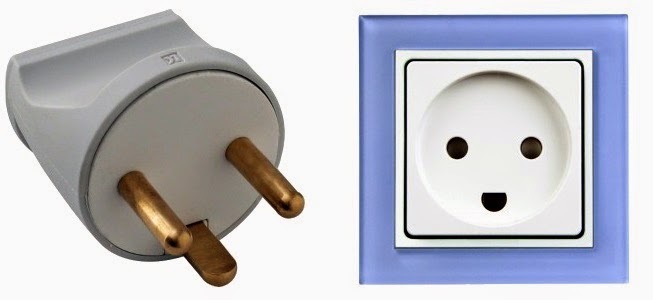
Type K is used almost exclusively in Denmark and Greenland. The Danish standard is described in DS 60884-2-D1. Unlike the similar type E plug, the grounding pin is not mounted in the receptacle, but it is on the plug itself. The U-shaped earthing pin is 14 mm long, 4 mm thick and has a 6.5 mm diameter. The line and the neutral pins of type K are round and have a 4.8 mm diameter. They are 19 mm in length and their centres are spaced 19 mm apart. The centre-to-centre distance between the earth pin and the middle of the imaginary line connecting the two power pins is 13 mm. The plug is rated at 16 A. A type C plug fits perfectly into a type K socket. The Danish socket will also accept plug types E and F: however, there is no grounding connection with these plugs because a male ground pin is required on the plug. Because of the huge amount of imported European appliances fitted with E/F plugs, the Danish government decided to make it legal to install type E or F sockets too. So, the expectation is that, in the long term, the standard European type F socket (or – but this is less likely – the less frequently used type E) will eventually replace the Danish type K socket.


Reference: WorldStandards

Sunday, November 2, 2014

Electrical: Power Plug & Outlet Type J

Type J is used almost exclusively in Switzerland and Liechtenstein. Switzerland has its own standard which is described in SEC 1011. This plug is similar to C, except that it has the addition of a grounding pin. Type J plugs have three 4 mm round pins, measuring 19 mm in length. The centres of the line and neutral prongs are spaced 19 mm apart and they have 10 mm long insulated sleeves. Older versions of this plug have unsleeved pins. Type J looks very much like the Brazilian type N standard, but it is incompatible with it since type J has the earth pin further away from the centre line than type N: the centre-to-centre distance between the earth pin and the middle of the imaginary line connecting the two power pins is 5 mm. This connector system is rated for use in applications up to 10 amps. Above 10 A, equipment must be either wired permanently to the electrical supply system with appropriate branch circuit protection or connected to the mains with an appropriate high power industrial connector. A type C plug fits perfectly into a type J socket.


Reference: WorldStandards

Electrical: Power Plug & Outlet Type I

Type I is mainly used in Australia, New Zealand, Papua New Guinea, China and Argentina. This 10 amp plug has two flat 1.6 mm thick blades, set at 30° to the vertical, forming an upside-down V. Their centres are spaced 13.7 mm apart and both prongs measure 17.3 mm in length and 6.3 mm in width. The flat earth blade also measures 6.3 by 1.6 mm, but it is 20 mm long. The distance between the centre of the grounding pin and the middle of the plug is 10.3 mm. There is an ungrounded version of this plug as well, with only two flat V-shaped prongs. Since 2004, all new type I plugs need to have insulated live and neutral pins.

Electrical: Power Plug & Outlet Type H

Type H is used exclusively in Israel and Palestine. This earthed 16 amp plug is unique to Israel. It has three 4.5 mm round prongs, measuring 19 mm in length and forming a triangle. The centres of the line and neutral pins are spaced 19 mm apart. The centre-to-centre distance between the earth pin and the middle of the imaginary line connecting the two power pins is 9.5 mm.

Related Posts Plugin for WordPress, Blogger...

Share This